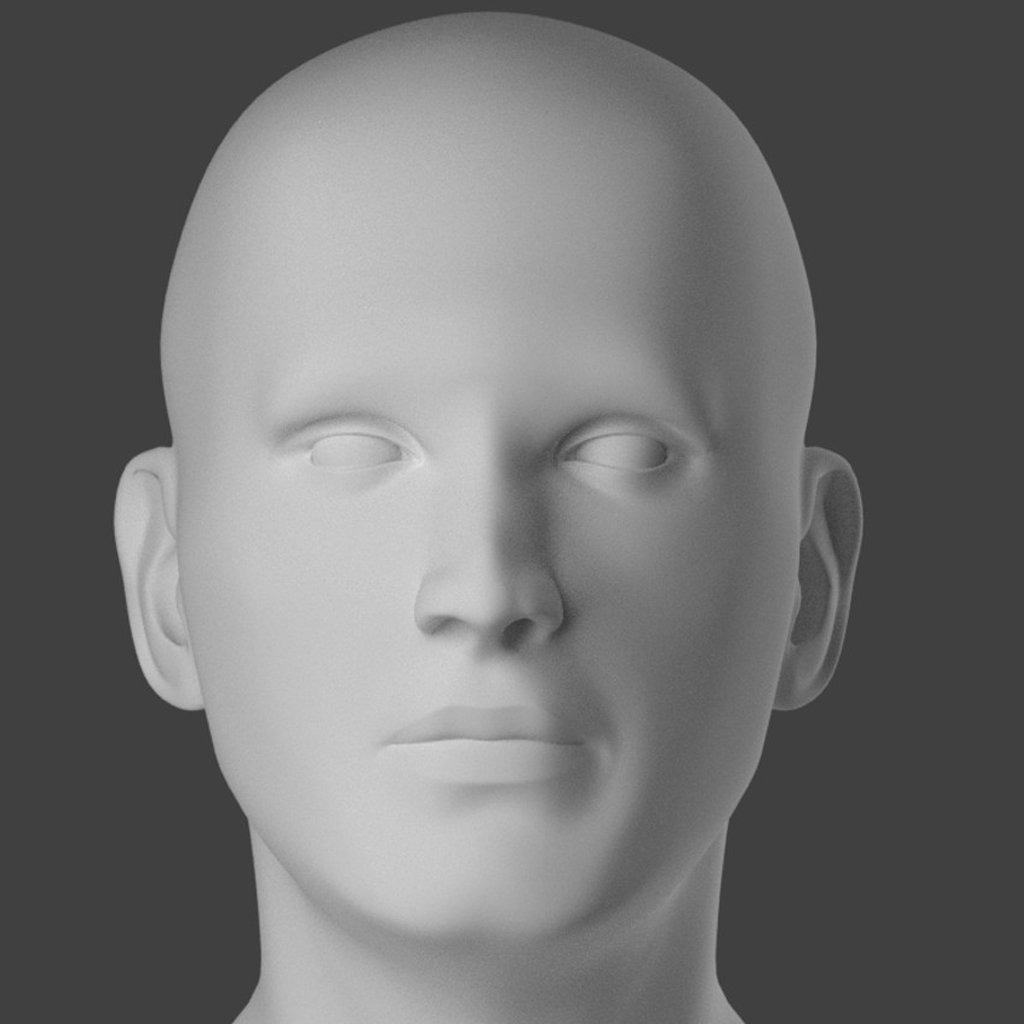
Pose any figure, from any angle, on any device.
A 3D reference model for artists. Pose the figure with no joint limits, study it from any angle, and take the pose into Blender, ZBrush or Maya.
4.1 out of 5 stars 4.1 on Google Play · 1,171 ratings
4.3 out of 5 stars 4.3 on the App Store
10,000+ installs
Since 2012 on the App Store
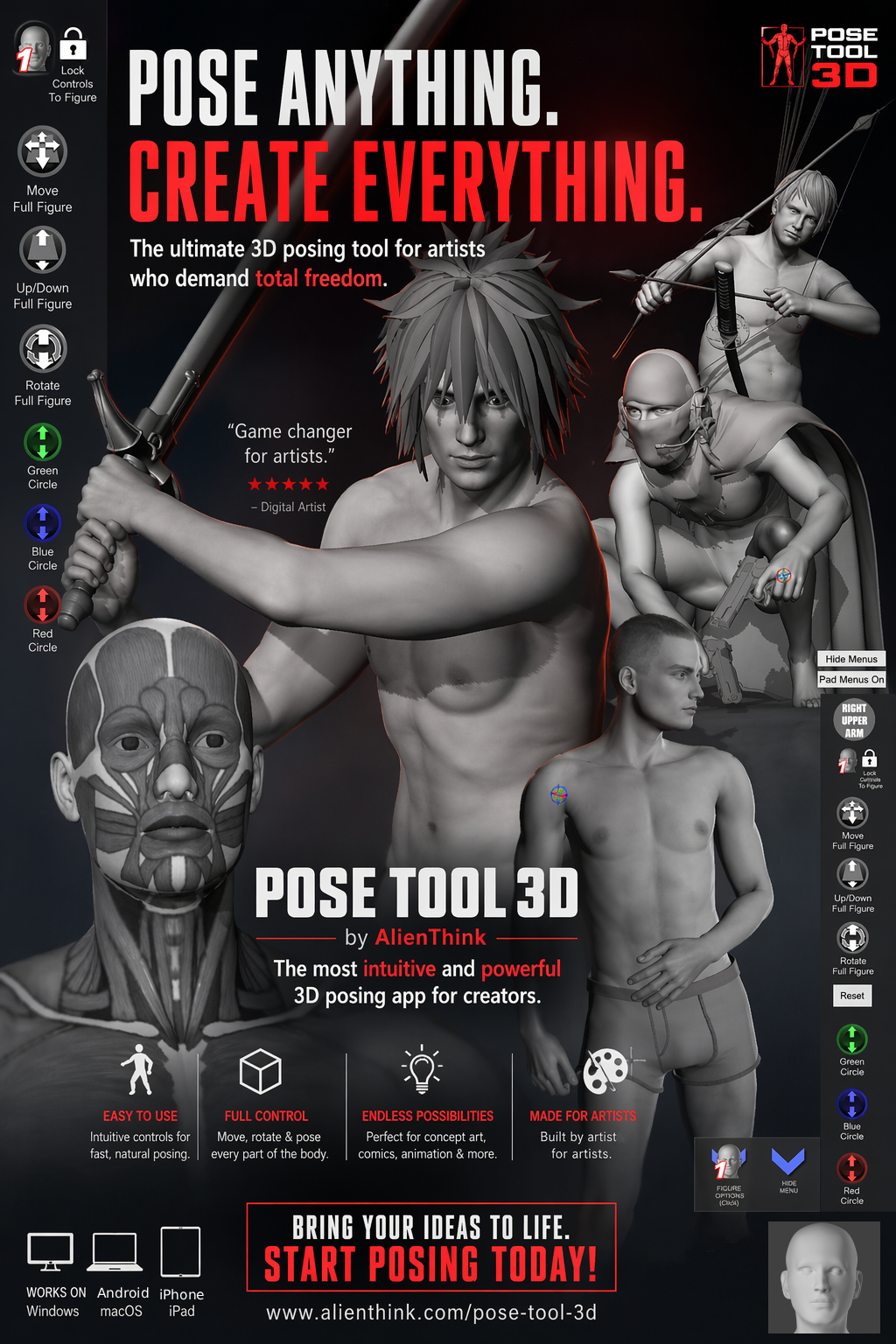
Pick the device you already draw on
Same figures, same controls, same saved poses. Pose on a phone on the train, finish on a desktop with a three-button mouse. One purchase per platform — no subscription, no per-pose fees.
Prices shown are the US list prices at the time of writing and can vary by region and store. Refunds are handled by each store under its own policy.
See Pose Tool 3D in action
Two walkthroughs: posing a character and exporting the mesh into ZBrush and Blender, and the complete guide to the posing controls, camera and lighting.
The original Pose Tool 3D demo has been watched more than 180,000 times. Word of mouth is still how most artists find the app — the reviews below are why.
Three things you can't get from a photograph
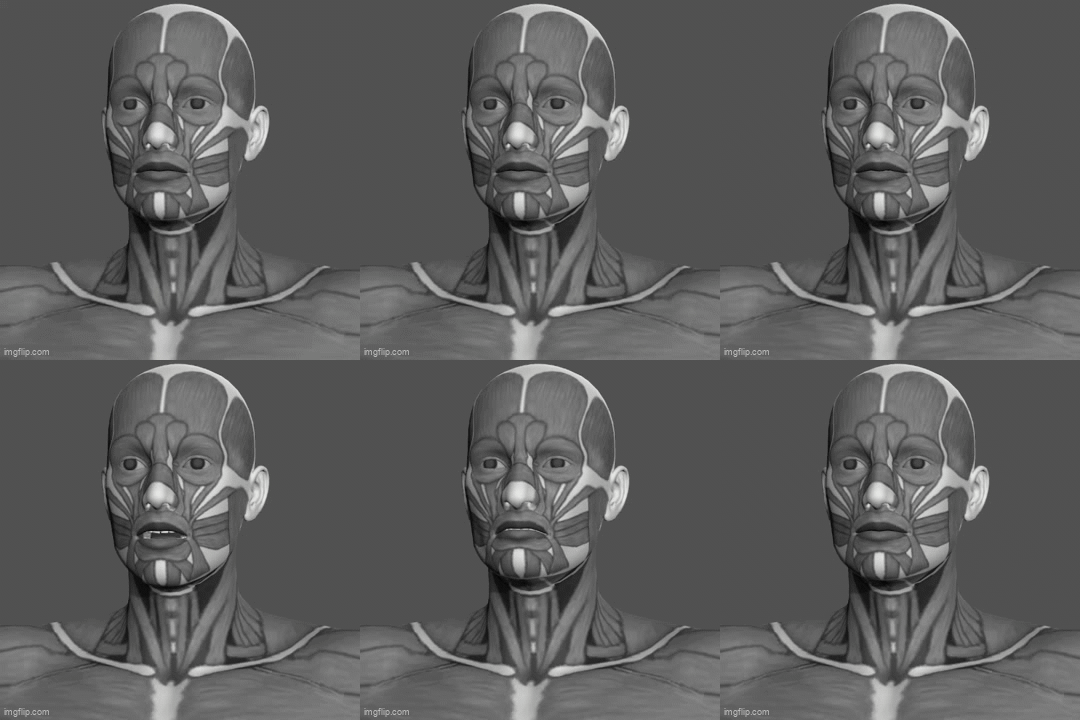
Anatomy you can strip down layer by layer
Muscle maps answer the question drawings usually fail on: where does this form start and end? Toggle muscles, skeleton, or both — the structure underneath becomes obvious.
- Muscle map overlay to study how form wraps and flexes
- Skeleton mode, skeleton sketch mode and comic + skeleton
- Gesture system mode for flow lines and the head cage
- Black body silhouette mode to check a pose as a shape
Fourteen ways to look at the same pose
Sketching, inking and painting are three different jobs, so Pose Tool 3D gives you a different view for each — from a pencil sketch to a manga filter for clean outlines, and life drawing in mono or colour.
- Muscle Maps
- Mannequin
- Black Body
- Pencil Sketch
- Pencil Sketch + Mannequin
- Pencil Sketch + Skeleton
- Comic Sketch
- Comic Sketch + Skeleton
- Skeleton
- Skeleton Sketch
- Life Drawing — Mono
- Life Drawing — Color
- Cube Guides
- Gesture System
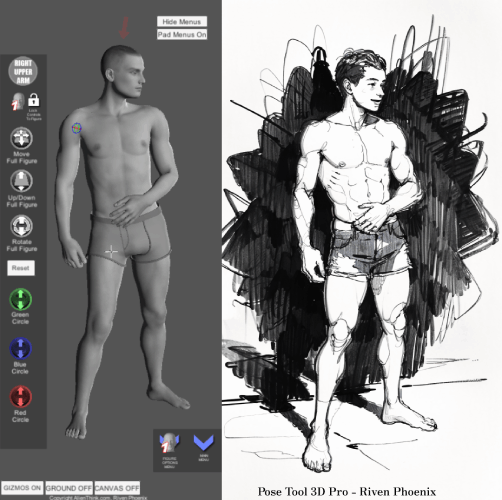

From pose, to sculpt, to finished work
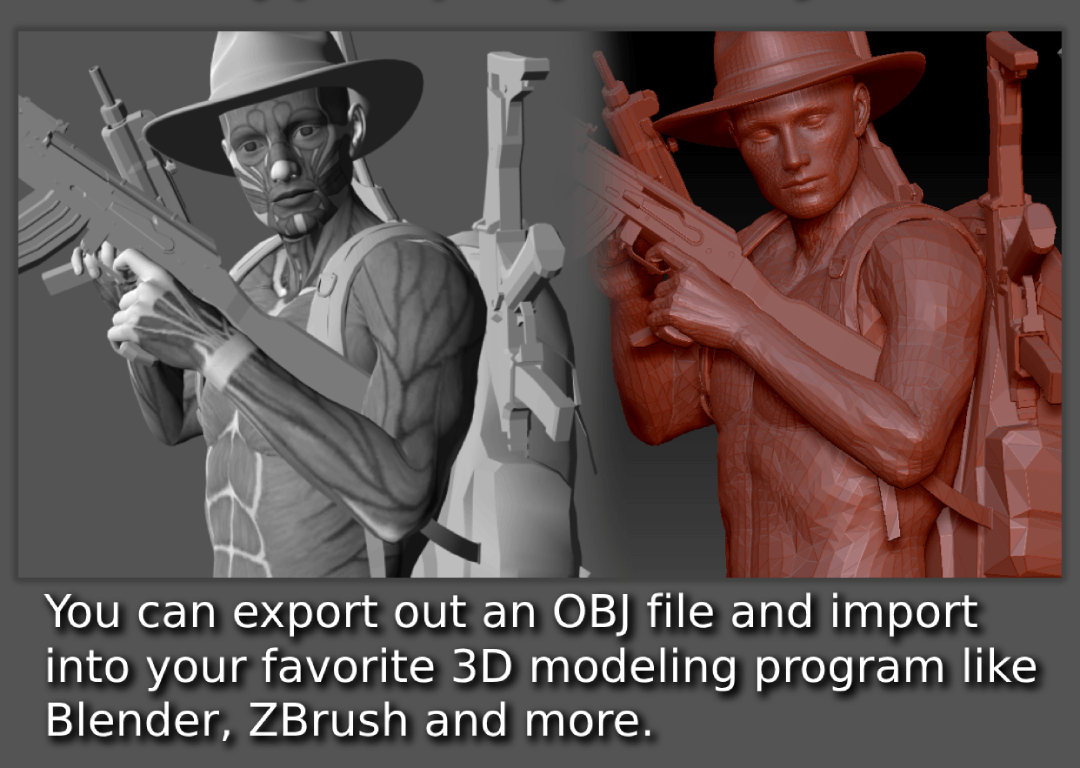
Export the pose as .obj and it opens in ZBrush, Blender, Maya or Nomad Sculpt as a base mesh you can sculpt on top of — no rig, no weighting, no surprises halfway through.
- .obj export of the posed mesh
- Manga / comic filter for clean outline drawings
- Pencil sketch and comic sketch screenshots for line reference
- JSON scene saves, 40 slots

Learn the method behind the app
Pose Tool 3D gives you the model. The figure drawing course teaches what to do with it — gesture, construction, proportion, anatomy and rendering, taught by the artist who made the app.
Start with a lesson
A lesson from the course itself — the anatomy exercises and the study method Riven Phoenix teaches from. Watch it here, then continue with the full course on Patreon.
- Gesture and the line of action
- Construction from simple volumes
- Proportion and landmarks
- Anatomy, light and rendering
Plates from the course
What artists actually wrote
Pose Tool 3D grew by word of mouth — artist to artist, forum to forum, desk to desk. These are real reviews from the App Store, Google Play and Steam.
Hands down this app is best of the best when it comes to posing figures for artists. Blows all other apps out of the water.
I'm a pro illustrator but some extreme angles are just too hard to visualize. Could hire a model for an hour OR USE THIS APP!
You can really tell this was made by an artist, for artists. I own a much more expensive and well-known program that does something similar but I never use it because it's overly complicated.
I've had this app for close to a decade, maybe more; I've seen its evolution. It keeps getting better and better, which leads me to believe the developer is actively invested in this app.
I love this app to help me get perspective and posing ideas for my art, for my comics and illustrated magazines. The fact that you can also pose the face is HUGE. Overall, this has become my #1 posing app.
Great tool for animators. In terms of user experience, it's a triumph.
Quotes are reproduced from public store listings and lightly trimmed where noted in the original. Spelling and phrasing are the reviewers'. Ratings read from the Google Play, App Store and Steam listings.
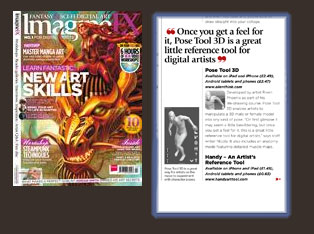
ImagineFX magazine, issue 92
"Top 10 Must-Have Art App."
The magazine's verdict was already the argument artists make today: you carry your own reference model with you, and the figures have no constraints — so realistic and extreme poses are both possible.

Riven Phoenix made it for Artists
I am a figure drawing instructor and the developer of Pose Tool 3D. I created Pose Tool 3D for all artists: a way to put a pose in front of students from any angle, and to solve the problem they kept hitting while drawing — an angle they could see in their head but not on the page.
I have been shipping updates to it since 2012, alongside my figure drawing lessons and the AlienThink apps for artists. Pose Tool 3D is now a defacto tool for artists everywhere.
Poses you can build in a sitting
Tap any screenshot to see it full size.
Every control in Pose Tool 3D
The complete manual, with screenshots — navigation, gizmos, multiple figures, draw modes, lighting and saving. Applies to Pose Tool 3D and Pose Tool 3D Pro.
2. Interface basics & gizmos
Posing controls
Select a body part, then use the green, blue and red rings on the left to rotate it on each axis. Move the whole figure with the Move, Up/Down and Rotate icons.


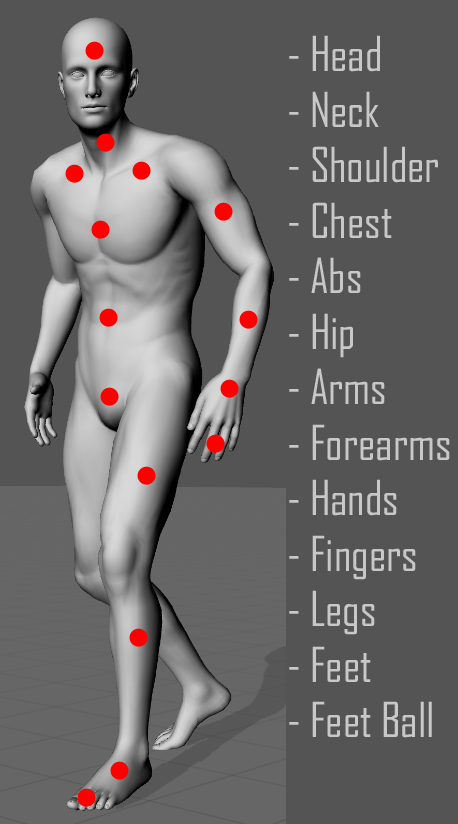
Selecting body parts
Every part is selectable down to individual fingers. When a part is selected, the body part icon shows you which one is active.

The gizmos
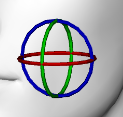
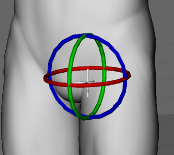
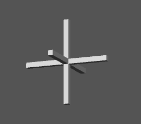
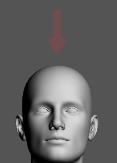
All gizmos can be hidden with the Gizmo button at the bottom left when you want a clean reference.
Ground plane
The ground plane is on by default and can be toggled off for a floating figure.
3. Managing multiple figures
Selecting a body part makes that figure active. Use the padlock icon to lock the pose controls to the active figure so you don't move the wrong character. Up to four figures can share a scene.
Figures can be switched on and off from the main menu — only the figures that are turned on are saved with the scene.
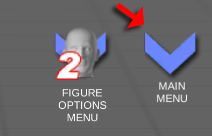
4. Figure options
The figure menu at the bottom right controls how the selected figure is displayed.
Body types and gender
Six male and six female body types: average, heavy, old, skinny, muscular and mannequin. Gender can be switched at any time.
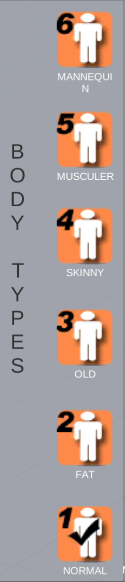

Skin color
Skin color is set per figure, which is useful when staging several characters together.
Reset, random and revert
Reset a figure to a T-pose, generate a random pose as a starting point, or revert to the last saved state.


5. Draw modes
Draw modes change how the figure is rendered, so you can match the app to the drawing you're about to make. Turn them on and off from the draw mode panel.
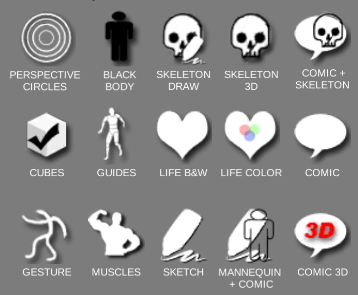
What each draw mode shows

Gesture
Flow lines and head cage to check the movement of the pose.

Cube guides
Boxes around the forms to check perspective direction.

Muscle maps
See how muscles wrap, stretch and compress as you pose.

Pencil sketch
Rough pencil lines for drawing guides and underdrawings.

Mannequin + comic
Blue construction lines under clean ink outlines.

Comic 3D
Shading guides drawn on the 3D mesh.

Guides
Face lines and joint dots for construction.

Life drawing — mono
Realistic texture and value study in grayscale.

Life drawing — color
Full realistic texture and color.

Comic
Pure line art, ready to ink.

Perspective circles
Concentric guides for foreshortening.

Black body
Silhouette check — does the pose read as a shape?

Skeleton 3D
Bone structure on its own.

Comic + skeleton
Ink outline with the bones showing through.

Skeleton sketch
Sketchy bones for building the figure from the inside out.

Muscular body type
One of twelve body types for proportion study.
6. Main menu & global settings

Save and load
Scenes save to 40 slots. Note that only figures that are turned on are saved. Scenes are now stored as JSON, so all figures and items are kept even when hidden.
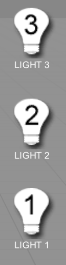
Three-point lighting
Three lights can be switched on and off individually. Only Light 1 casts shadows — turning the other shadows off is the easiest way to speed up the app on older devices.
Camera, grid and backgrounds
| Center camera | Reset the view to the figure |
| Grid | Toggle perspective grid planes |
| FOV | Change the lens — wide angle for dramatic distortion, long for flat reference |
| Lock rotation | Freeze the camera angle while you pose |
| Camera Lucida | Trace over the live camera feed |
| Background image | Load a photo from your device behind the figure |
Adding figures
Up to four figures can be enabled in one scene, each with its own body type, skin color, pose and props.
Screenshots and export
Take a screenshot to use as drawing reference in whichever draw mode is active, and export the posed mesh as an .obj file for ZBrush, Blender, Maya or Nomad Sculpt.
7. Getting fast
The ten-minute version
- Learn one body part first — an arm — and get used to which ring moves which axis.
- Use the keyboard shortcuts on desktop instead of the on-screen arrows.
- Pose the hips early. The hip gizmo sets the whole figure's angle, and everything else reads better once it's right.
- Use undo rather than fighting a joint back into position.
Habits from experienced users
- Turn off shadows and extra lights on older hardware for a smoother framerate.
- Save a neutral T-pose scene you can load as a clean starting point.
- Use random pose as a warm-up generator for timed gesture drawing.
- Check the pose in black body mode before you commit — if the silhouette doesn't read, nothing else will.
Everything artists ask before buying
What is Pose Tool 3D?
Pose Tool 3D is a 3D figure posing app for artists. You move a digital male or female figure into any position, study it from any camera angle, switch on muscle, skeleton or sketch overlays, and draw from it. It is used for figure drawing, illustration, comic and manga art, character design, storyboarding, animation and 3D sculpting.
Which platforms does it run on?
iPhone and iPad (App Store), Android phones and tablets (Google Play), Windows PC (Steam, Microsoft Store and Gumroad) and Mac (Mac App Store and Gumroad). One purchase per platform. See the platform list for links and prices.
How much is it, and is it a subscription?
$6.99 (US list price) on the App Store, Mac App Store and Steam. It is a one-time purchase, not a subscription, and there are no per-pose or export fees. Regional prices vary by store.
How long does it take to learn?
Budget ten minutes for the controls. They use levers and axis rings rather than drag-the-limb gestures, which makes posing precise and repeatable but takes a little getting used to. Desktop keyboard shortcuts (WASDQE) and per-figure undo make it much faster once the axes click. The free manual covers every control with screenshots.
Can I export a pose into Blender, ZBrush, Maya or Nomad Sculpt?
Yes. Posed figures export as .obj meshes that import into ZBrush, Blender, Maya, 3ds Max, Nomad Sculpt and other 3D tools — so you can block out a pose and sculpt on top of it without rigging a character first.
Does it work offline?
Yes. Posing, draw modes, lighting and saving all run on the device. You only need a connection to buy it from a store or to watch the embedded tutorial videos.
Can I see it in action before I buy?
Yes — there are full walkthrough videos on this page, a complete free manual, and detailed guides for every kind of artist. Refunds are handled by the store you purchased from (App Store, Google Play, Steam, Microsoft Store or Gumroad) under their own policies.
Stop searching for the angle. Pose it.
One-time purchase. Works offline. On the device that's already in front of you.
See all six platforms · Mac App Store · Microsoft Store · Gumroad
Want the drawing method too? The figure drawing course