In Lesson 1, we introduced the concept of invention. Now, in Lesson 2, we must prove to the mind that it can create its own rules for understanding figure drawing. This begins with establishing the core structure of the human figure from the absolute front view.
The very first step: starting with a simple vertical block to map out our creation.
Imprinting the Front View Proportions
We are going to forcefully imprint the structure of the human blueprint directly into your memory. This involves breaking down the complex curvature of the ribcage, the pivot points of the limbs, and the geometric simplicity of the joints. To invent, your brain needs to understand the "toolkit" of basic shapes.
We start by bisecting the overall height to find the crotch line. From there, another bisection between the crotch and the feet gives us the knee line. We divide the top half to find the base of the pectoral muscles, and then segment further to locate the chin and the navel.
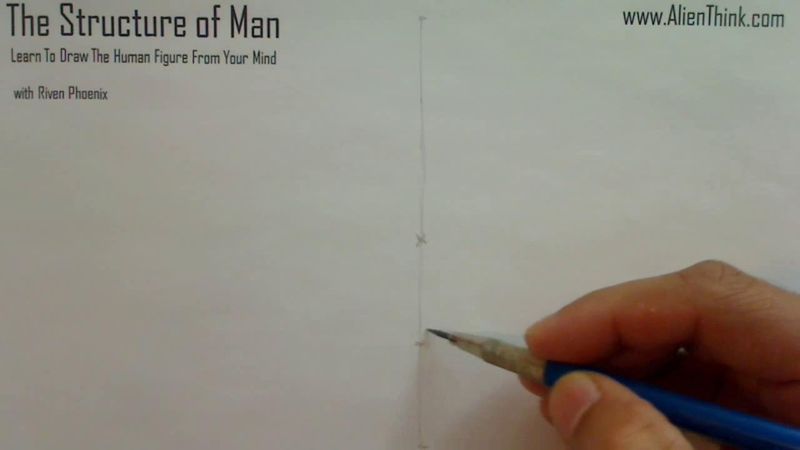
Establishing the simple mathematical relationships: the knees always sit above the bottom bisected line.
Sculpting the Chest Cavity and Pelvis
Next, we build the organic shapes over this skeleton. From the chin to the pectorals, we find the V-shape of the clavicle. Below the pectorals, we curve down slightly to establish the chest cavity's shape.
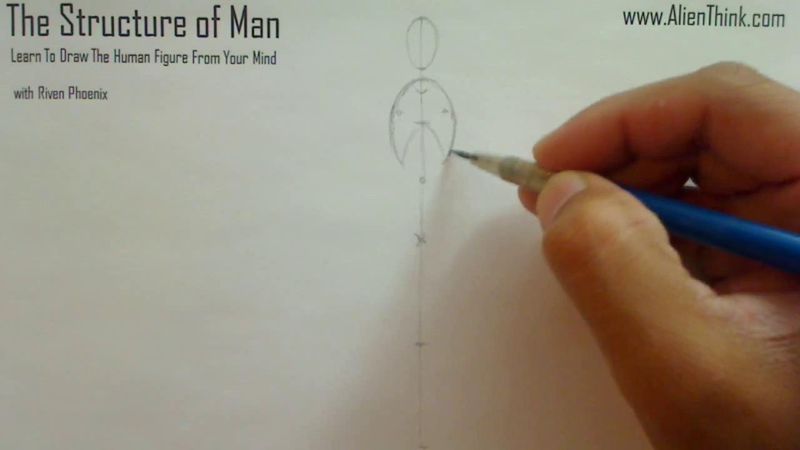
The chest cavity curves securely beneath the pectoral muscles.
For the pelvis, we measure between the navel and the crotch area, dividing this space into thirds. These divisions provide precise anchor points for the love handles and the ball joints of the legs, taking the guesswork out of anatomy.
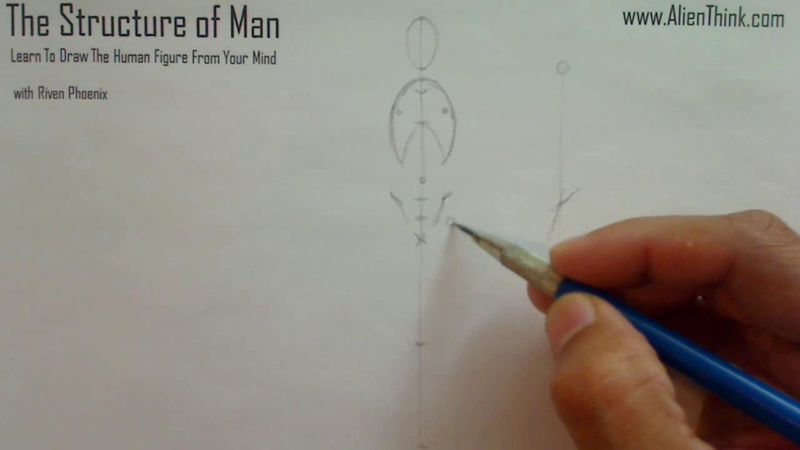
By mapping out the thirds, we perfectly seat the ball joints of the hips.
Proving the Concept: The First Complete Sketch
With our anchors placed, we attach the simple, pendulum-like shapes of the arms and the structural lines of the legs leading down to basic wedge feet. By the end of this exercise, you will have drawn a perfectly proportioned structural figure from pure imagination.
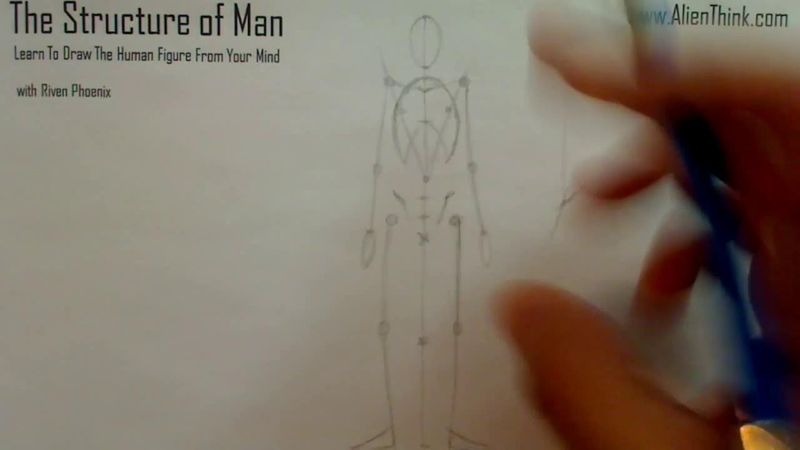
The completed phase 1 core structure. This sketch proves the power of the invention formula.
This acts as undeniable proof that the systemic training approach works. You are no longer guessing at proportions; you are executing a structural formula. In our next phase, we'll turn the figure around and explore the complexities of the back view.
Ready to learn the exact formulas?
This article is a tiny glimpse into the massive 92-hour curriculum of The Structure of Man. Stop copying references and start drawing from your imagination today.
Get The Full Course on Gumroad